Matcha Latte at Home: Caffeine and Calm Energy
A creamy green latte made from powdered tea leaves. It has real caffeine, so here is how much to expect and what the calm-energy claims are based on.
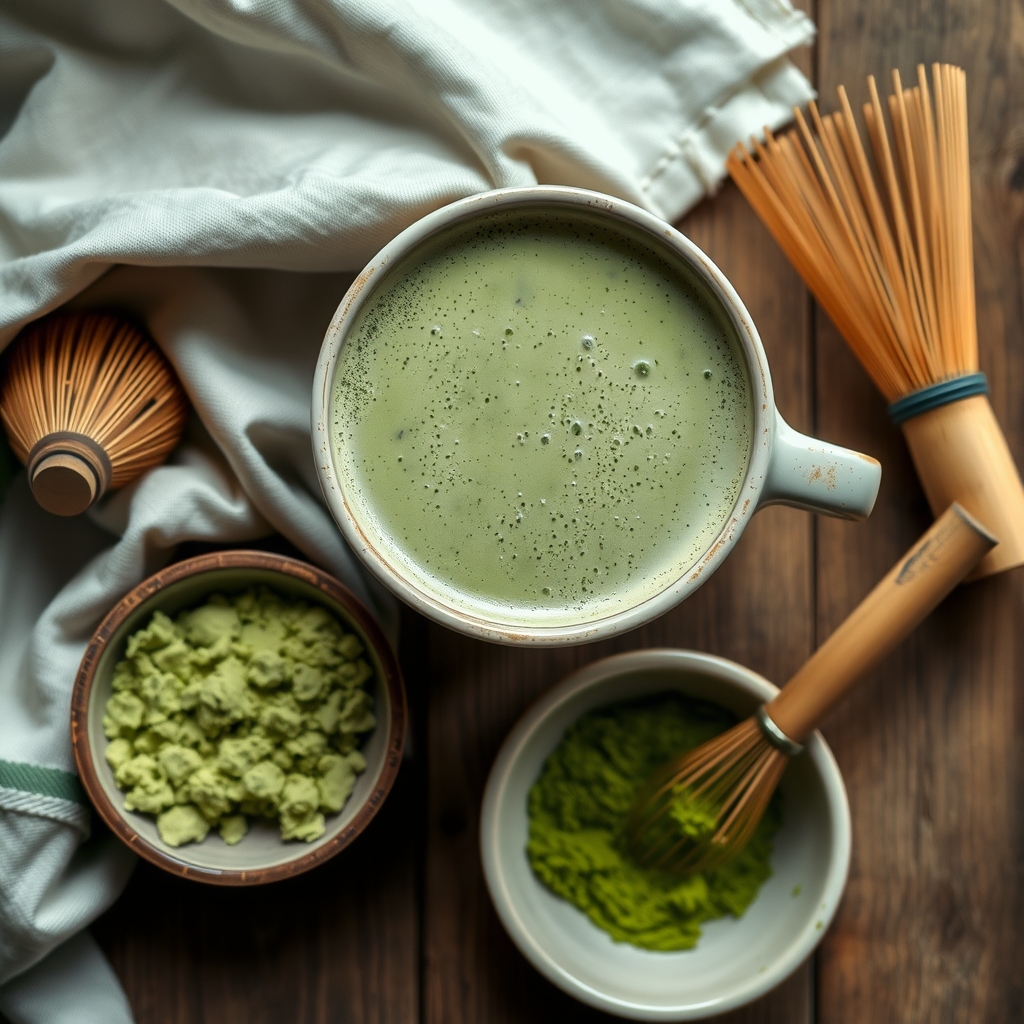
Matcha is green tea leaf ground into a fine powder. Instead of steeping leaves and throwing them away, you whisk the powder into water and drink the whole leaf. Add warm milk and you have a matcha latte.
People often describe matcha as giving a calmer kind of energy than coffee. There is a little research behind that idea, but it is early, and matcha still contains caffeine you need to count.
Why people drink it
Matcha has a sweet, grassy, slightly savory taste, and milk softens any bitterness. Many people enjoy it as a gentler morning drink or an afternoon pick-me-up.
Because you drink the powdered leaf, a matcha latte can taste much stronger than a cup of brewed green tea. How strong it is depends mostly on how much powder you use.
Simple Matcha Latte
You need
- matcha powder1/2-1 tsp (1-2 g)
- hot water, about 80 °C (175 °F)60 ml (1/4 cup)
- milk or unsweetened plant milk180 ml (3/4 cup)
- sugar or maple syrup (optional)0-1 tsp
Method
- Sift the matcha into a wide mug or bowl to break up lumps.
- Add the hot water. Whisk briskly in a zigzag motion with a small whisk or a milk frother for about 20 seconds, until smooth and lightly foamy.
- Warm the milk in a small pan or the microwave until steaming but not boiling. Froth it if you like.
- Pour the milk over the matcha and stir in sweetener if using.
- Let it cool until comfortable to sip before drinking.
Tips
- Start with 1/2 tsp of matcha if you are sensitive to caffeine. You can always add more next time.
- Boiling water makes matcha taste bitter. Let a just-boiled kettle stand for 3 to 4 minutes first.
- For an iced latte, whisk the matcha with the hot water, then pour over ice and cold milk.
What the evidence says
Matcha comes from the same tea plant as other green tea. NCCIH reports no safety concerns for adults drinking green tea as a beverage, but says definite conclusions cannot yet be reached about whether green tea helps with most of the things it is promoted for.
The calm-energy idea comes from the pairing of caffeine with theanine, an amino acid found in tea. In a randomized, placebo-controlled study in middle-aged and older adults, people took matcha capsules containing about 66 mg of caffeine and 48 mg of theanine a day. The researchers reported that, after 12 weeks, the matcha group did more work on a task done under mild stress, while caffeine alone helped mainly after a single dose.
That is one study, using capsules rather than lattes, in one age group. It is interesting, but it does not prove that a matcha latte will make you calmer or more focused. Treat it as a pleasant drink, not a treatment for stress or tiredness.
How much caffeine is in a matcha latte
Caffeine in matcha varies by product and by how much you use. In the study above, about 2 g of matcha powder, roughly 1 tsp, provided around 66 mg of caffeine. That is more than a typical cup of brewed green tea and less than a typical cup of brewed coffee.
Mayo Clinic says up to 400 mg of caffeine a day seems safe for most healthy adults. Count your matcha along with coffee, tea, cola and energy drinks.
Too much caffeine can cause headache, trouble sleeping, nervousness, a fast heartbeat, shakiness and an upset stomach. If you get these, use less powder or have your latte earlier in the day.
Questions people ask
Does a matcha latte have more caffeine than coffee?
Usually less than a cup of brewed coffee, but more than a cup of brewed green tea. It depends on how much matcha powder you use.
Why does matcha feel calmer than coffee?
Tea contains theanine alongside caffeine. One small study found people taking matcha capsules for 12 weeks performed better on a task under mild stress than those taking caffeine alone, but the research is still limited.
Can I drink a matcha latte every day?
Most healthy adults can, as long as total caffeine stays within about 400 mg a day. Skip it if you are sensitive, and watch added sugar.
Sources
- Green Tea: Usefulness and Safety — NCCIH
- Effects of Daily Matcha and Caffeine Intake on Mild Acute Psychological Stress-Related Cognitive Function in Middle-Aged and Older Adults — Nutrients (PubMed Central)
- Caffeine: How much is too much? — Mayo Clinic
- Caffeine content for coffee, tea, soda and more — Mayo Clinic
This article is for general information only and is not medical advice. Herbs can interact with medicines and health conditions. Talk to a doctor or pharmacist before trying a herbal remedy, especially if you are pregnant, breastfeeding, giving it to a child, or taking any medication.