Fridge Smells: Baking Soda, Coffee and Citrus Peel
Baking soda and fresh coffee grounds can soak up lingering fridge smells, while citrus peel only adds a fresh scent. The real fix starts with finding the source and cleaning.
A smelly fridge is one of those small problems that makes the whole kitchen feel less fresh. The usual suspects are a forgotten container of leftovers, a spill that dried under a drawer, or strong foods like onions, fish and cheese stored without a lid.
Kitchen staples can help: an open box of baking soda, a tray of ground coffee or a few pieces of citrus peel. But they work in different ways, and none of them replaces a good clean. Here is what each one does and how to deal with smells properly.
Start with the source
Before you reach for any odor absorber, look for the cause. Check the back of each shelf, the drawers, the door shelves and the seal around the door. A small puddle of spilled milk or juice can smell far worse than its size suggests.
The FDA advises keeping the fridge clean, wiping spills right away and throwing out anything that looks or smells suspicious. If you are not sure about a food, throw it out. Smell is not a safe test, because the bacteria that cause food poisoning are different from the ones that make food smell bad, and food can make you ill even when it smells fine.
Fridge Deep Clean and Odor Absorber
You need
- baking soda, for the cleaning solution15 ml (1 tbsp)
- warm water1 liter (1 quart)
- baking soda, for the odor bowlabout 110 g (1/2 cup)
- fresh, dry ground coffee (optional, for stubborn smells)about 40 g (1/2 cup)
- lemon or orange (optional, for scent)peel of 1
Method
- Take all food out. Keep cold items in a cool bag, and throw away anything spoiled, past its date or doubtful.
- Remove shelves and drawers and wash them in hot soapy water. Rinse and dry.
- Mix 15 ml (1 tbsp) of baking soda into 1 liter (1 quart) of warm water. Wipe the inside walls, the door shelves and the rubber seal, then wipe again with clean water and dry.
- Leave the door open for about 15 minutes to air it out, then put the shelves back and turn the fridge on.
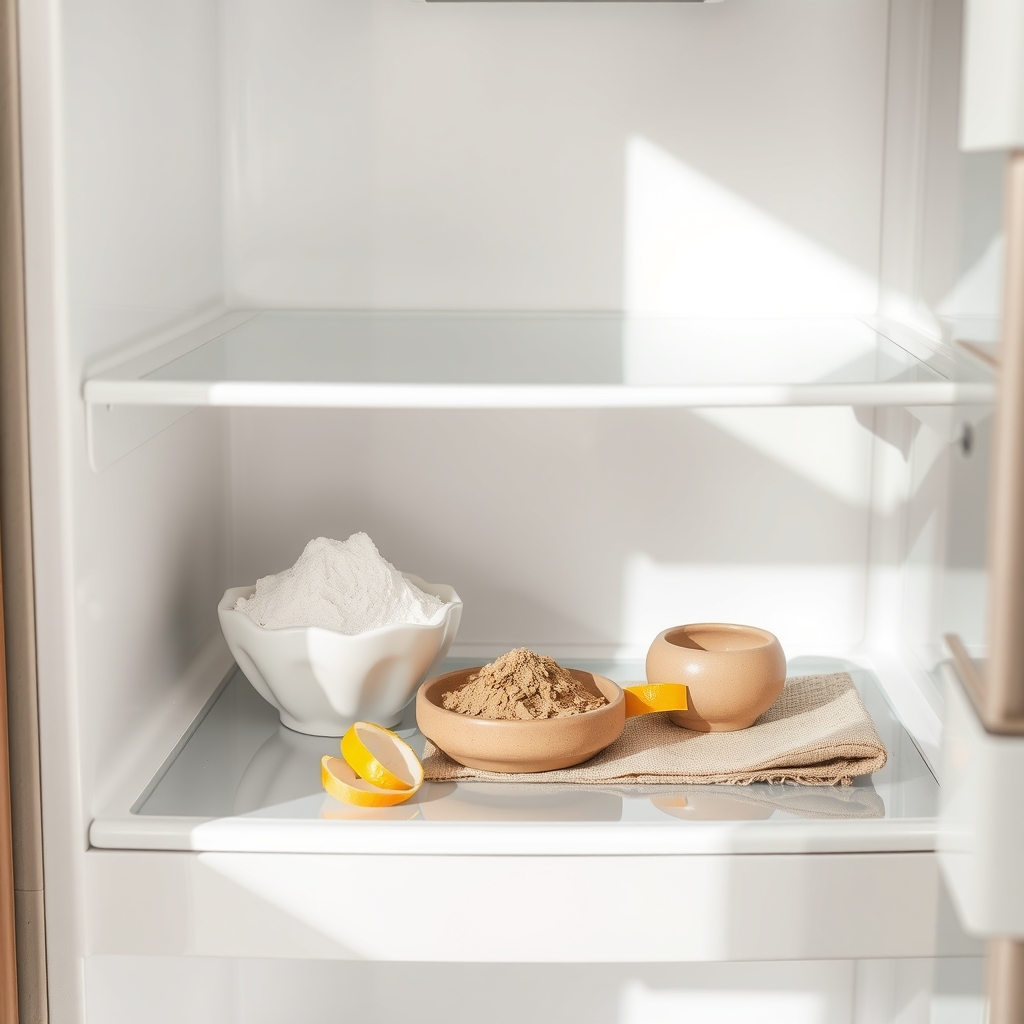
- Put an open bowl of baking soda on a middle shelf. For a stubborn smell, spread fresh ground coffee on a baking tray and leave it in the empty, closed fridge for 2 to 3 days before restocking.
- Once the fridge smells clean, you can add a few strips of citrus peel on a saucer for a fresh scent. Throw them away within 2 to 3 days.
Tips
- Use fresh, dry coffee grounds. Damp used grounds can go moldy.
- If you prefer to sanitize after spoiled meat or a power outage, use bleach only on its own, diluted as the label says, and never mix it with vinegar, ammonia or any other cleaner.
- If smells keep coming back after cleaning, the drain hole or the insulation may hold the odor. Ask the manufacturer or an appliance technician.
What the evidence says
University extension services recommend baking soda and fresh coffee as odor absorbers, along with activated charcoal, which is sold for aquariums. Penn State Extension and the University of Nebraska suggest placing trays of these on the shelves for stubborn smells. For a fridge that smells after spoiled food, they advise running it empty with the absorber inside for 2 to 3 days.
These are practical recommendations based on experience rather than careful studies, but baking soda and charcoal are widely used because they work reasonably well in a closed space. Fresh, dry coffee grounds absorb some odor too, though they also leave a coffee smell behind.
Citrus peel is different. It does not absorb odors; it adds its own fresh scent on top, and none of these sources lists it as an odor remover. It is fine for a pleasant smell after cleaning, but it will not fix the cause, and the peel itself will go moldy within days.
Keeping it fresh
Store strong-smelling foods in sealed containers. Check the back of the fridge once a week and use up or throw out old leftovers.
The FDA advises keeping your fridge at or below 4 °C (40 °F), and using an appliance thermometer to check it. A fridge that runs too warm lets food spoil faster, which means more smells.
Replace an open box or bowl of baking soda every few months, or sooner if it starts to clump or the smells come back.
Questions people ask
Does baking soda really absorb fridge smells?
It helps with mild, lingering smells in a closed fridge, and extension services recommend it. It works best after you have removed the source and cleaned.
Are coffee grounds better than baking soda?
Fresh ground coffee can help with stubborn smells, especially in an empty fridge over 2 to 3 days, but it leaves a coffee scent. Baking soda is more neutral for everyday use.
Does lemon peel remove odors?
No. Lemon or orange peel adds a fresh smell but does not absorb odors. Use it only after cleaning, and replace it every couple of days.
Sources
- Eliminating Odors from the Refrigerator and Freezer — Penn State Extension
- Solving Odor Problems in Your Refrigerator or Freezer — University of Nebraska-Lincoln
- Are You Storing Food Safely? — FDA
- How to Safely Clean and Sanitize with Bleach — CDC
This article is for general information only and is not medical advice. Herbs can interact with medicines and health conditions. Talk to a doctor or pharmacist before trying a herbal remedy, especially if you are pregnant, breastfeeding, giving it to a child, or taking any medication.