DIY Herbal Shampoo: What to Know Before You Mix
Homemade herbal shampoo sounds simple: some herbs, some soap, a bottle. The chemistry is less simple. Here is what a shampoo really has to do, where many online recipes go wrong, and a gentle small-batch version you can make safely.
Making your own shampoo is one of the most popular herbal projects online. People like the idea of knowing exactly what goes on their head, of using herbs from the garden, and of cutting down on plastic bottles.
Those are good reasons. But shampoo has a real job to do, and many recipes use plain soap, which behaves very differently on hair. Before you start mixing, it helps to know a little science, and how to keep a homemade product from spoiling.
What shampoo actually has to do
The main thing shampoo removes is sebum, the natural oil made by your scalp, along with sweat, dust and product buildup. Sebum is a fat that does not dissolve in water, which is why rinsing with water alone leaves hair greasy. Shampoos use cleansing ingredients called surfactants, which surround the oil and let it be carried away in the rinse water, as a review of hair cosmetics in the International Journal of Trichology explains.
This is the first thing to know about herbal shampoo: the herbs do not do the cleaning. A tea of rosemary, nettle or chamomile is mostly water. It can add scent and a pleasant ritual, but on its own it cannot lift oil from your scalp. Something in the recipe still has to act as the cleanser.
Small-Batch Herbal Shampoo
You need
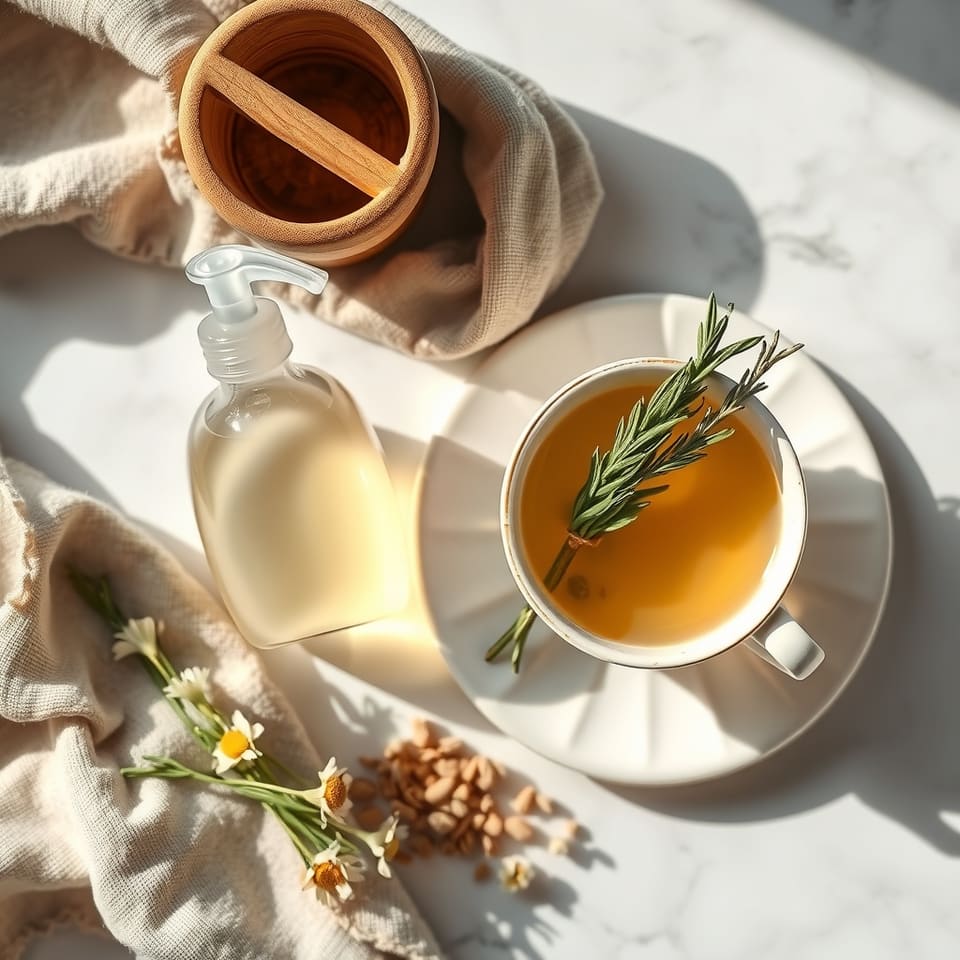
- dried chamomile flowers, or 1 tbsp chopped fresh rosemary leaves1 tbsp
- water, just off the boil60 ml (1/4 cup)
- mild, fragrance-free shampoo60 ml (1/4 cup)
- clean, dry bottle with a lid, about 100 ml1
Method
- Wash the bottle in hot, soapy water, rinse it well and let it dry completely.
- Put the herb in a cup, pour over the hot water, cover and steep for 15 minutes to make a strong infusion.
- Strain through a fine sieve or a coffee filter so no plant bits remain, then let it cool completely.
- Pour the shampoo into the bottle and add 2 tbsp (30 ml) of the cooled infusion. Close and shake gently to mix.
- Label the bottle with the date and keep it in the fridge.
- To use, apply a small amount to your wet scalp, massage gently and rinse well. Follow with conditioner on the lengths if you usually use one.
Tips
- The AAD advises putting shampoo on your scalp rather than the full length of your hair, which cleans buildup without over-drying the ends.
- Because the infusion dilutes the shampoo, it will lather a little less. That does not mean it cleans worse, but you may need a second small amount for very oily hair.
- Use any leftover infusion as a final rinse, or discard it. Do not keep it at room temperature.
The problem with soap-based recipes
Many homemade shampoo recipes use liquid soap as the cleanser. Soap does clean, but it is alkaline. The same review notes that soap leaves an alkaline residue that can harm hair and skin, and that it can react with minerals to form deposits that build up on strands, leaving hair dull and tangled. This is more noticeable in hard water.
Hair is also sensitive to pH. Alkaline solutions make the hair fiber swell and lift the outer cuticle scales, which can make hair more prone to friction and breakage. This helps explain why hair can feel rough or waxy after a few washes with soap.
If you want a homemade product, a gentler approach is to start with a mild, fragrance-free shampoo as the base and add your own herbal infusion to it. You get the herbs you like, without trading a carefully balanced cleanser for one that is harsh on hair.
What the evidence says
We could not find good studies testing homemade herbal shampoos on people, so there is no evidence that adding herbs to shampoo makes hair grow, stops hair loss or treats dandruff. Treat the herbs as scent and enjoyment.
Natural does not automatically mean safe. The US Food and Drug Administration (FDA) points out that it has not defined the word natural for cosmetics, and that ingredients from natural sources are not guaranteed to be safe. The FDA also warns that microbial contamination can make a cosmetic a health hazard. Commercial shampoos contain preservatives for this reason. A homemade mix of shampoo and herbal tea has much more water and plant material in it, and no added preservative, so it should be treated like fresh food: made in small amounts, kept cold and used up quickly.
If your main problem is dandruff, herbs are not the best tool. The American Academy of Dermatology (AAD) recommends shampoos with active ingredients such as zinc pyrithione, salicylic acid, selenium sulfide, ketoconazole, sulfur or coal tar.
Questions people ask
Can I make shampoo from herbs alone, with no soap or shampoo base?
Not really. Herbal tea is mostly water, and water alone cannot remove scalp oil. You still need a cleanser.
Is liquid castile soap a good shampoo?
Soap is alkaline and can leave a residue that makes hair dull and tangled, especially in hard water. Many people find a mild shampoo works better and use herbs only for scent.
Why does my homemade shampoo need to go in the fridge?
Adding herbal tea adds water and plant material without a preservative, which makes it easier for microbes to grow. Cold storage and small batches lower that risk.
Sources
- Hair Cosmetics: An Overview — International Journal of Trichology (PubMed Central)
- Small Businesses & Homemade Cosmetics: Fact Sheet — US Food and Drug Administration
- Tips for healthy hair — American Academy of Dermatology
- How to treat dandruff — American Academy of Dermatology
This article is for general information only and is not medical advice. Herbs can interact with medicines and health conditions. Talk to a doctor or pharmacist before trying a herbal remedy, especially if you are pregnant, breastfeeding, giving it to a child, or taking any medication.