Bone Broth Benefits: What Is Myth and What Is Fact
Bone broth has been called the new coffee, with promises of stronger joints, smoother skin and better immunity. A warm bowl can be lovely food, but the big claims run far ahead of the science.
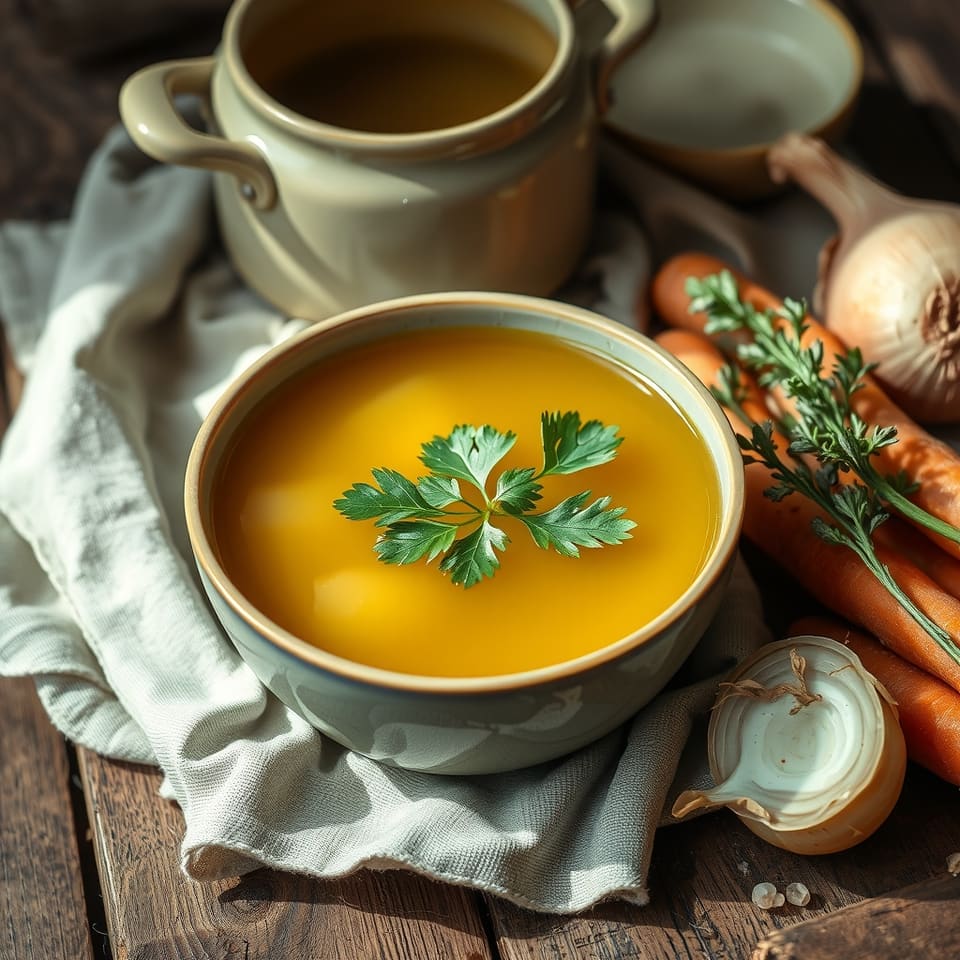
Almost every kitchen in the world has its own long-simmered broth, from a pot of chicken soup to slow-cooked stocks that form the base of noodle soups and stews. Bone broth is simply that idea in a cup: bones, vegetables and water cooked gently for hours.
In recent years it has turned into a wellness trend. It is sold in cartons and cafes, sipped through the day, and promoted for joints, skin, gut and immunity. Here is a fair look at those claims, what the evidence actually says, and how to make a lower-salt version at home if you enjoy it.
The claims behind the trend
The main selling point is collagen. Bones, skin and joints are rich in collagen, so the idea is that simmering them releases collagen and its building blocks into the liquid, and that drinking it will help your own joints, tendons and skin.
Other common promises include stronger bones, a calmer gut, fewer wrinkles and better immune function. Harvard Health notes that bone broth has become hugely popular, with some fans calling it the new coffee, and that the media coverage relies heavily on personal testimonials.
Herb-Simmered Chicken Bone Broth
You need
- chicken bones, wings or a leftover roast chicken carcass1 to 1.2 kg (2 to 2 1/2 lb)
- cold water3 liters (12 cups)
- onion, halved, skin on1
- carrots, cut into chunks2
- celery stalks, cut into chunks2
- bay leaves2
- sprigs of fresh thyme4 to 5
- parsley stalks1 small handful
- black peppercorns6
- salt, added only when servingto taste
Method
- For a deeper flavor, roast the bones on a tray at 200 °C (400 °F) for about 30 minutes. This step is optional.
- Put the bones in a large pot, cover with the cold water and bring slowly to a gentle simmer. Skim off any foam that rises in the first 20 minutes.
- Add the onion, carrots, celery, bay leaves, thyme, parsley stalks and peppercorns.
- Simmer very gently, uncovered or partly covered, for 3 to 4 hours. Top up with a little hot water if the bones become exposed.
- Strain through a fine sieve and discard the bones and vegetables.
- Divide the broth into shallow containers so it cools quickly, and refrigerate within 2 hours. Lift off the fat from the top once chilled, if you like.
- Reheat only what you need, bringing it to a rolling boil, and season with salt at the table.
Tips
- Keep the broth in the fridge for 3 to 4 days, or freeze it in portions for 3 to 4 months.
- Freeze some in an ice cube tray so you can add a little flavor to rice, grains or sauces.
What the evidence says
Harvard Health says the claims about arthritis, immunity and skin often go beyond the evidence, and that there is little scientific evidence for benefits such as bone strength or fewer wrinkles.
The collagen idea has been tested more directly. A 2019 study by Australian sports nutrition researchers analyzed bone broths, both bought and homemade, for six amino acids that are building blocks of collagen. Broths made with a standard recipe had lower levels than a 20 g dose of the collagen supplements used in research. Broths made in other ways varied widely from one to the next. The authors concluded that bone broth is unlikely to be a reliable source of these building blocks.
That does not make broth bad food. It is warm, savory and comforting. It is just not a proven treatment for joints, skin or immunity.
The facts that matter more: salt and storage
Salt is the bigger practical issue. Mayo Clinic notes that prepared and packaged foods supply most of the sodium people eat, and suggests choosing broth labeled low sodium or making your own. The World Health Organization advises no more than 2,000 mg of sodium a day. When you buy broth, check the label: in the US, low sodium means 140 mg or less per serving, and Mayo Clinic suggests avoiding products with more than 200 mg per serving.
Food safety matters too, because a big pot of broth cools slowly. The US Department of Agriculture advises refrigerating cooked food within 2 hours, dividing large amounts into shallow containers so they cool quickly, and bringing soups to a rolling boil when you reheat them. Leftovers keep 3 to 4 days in the fridge or 3 to 4 months in the freezer for best quality.
A safer way to enjoy it
If you like bone broth, make it at home with plenty of vegetables and herbs and add salt only at the end, to taste. Use it as the base of a soup with beans, grains and greens rather than sipping cup after cup as a supplement. You get the comfort and flavor, you control the salt, and you are not paying a premium for promises the evidence does not support.
Questions people ask
Does bone broth contain collagen?
Broth contains some of the building blocks of collagen, but a 2019 analysis found the amounts were lower than in the collagen supplements used in research and varied widely between recipes, so it is not a reliable source.
Is store-bought bone broth healthy?
It can fit into a normal diet, but most of the sodium people eat comes from prepared and packaged foods, so check the label. Look for low-sodium versions, which have 140 mg or less per serving in the US.
Is bone broth better than regular stock?
Not in any proven way. Both are bones and vegetables simmered in water, and Harvard Health says there is little scientific evidence behind the health claims made for bone broth.
Sources
- What's the scoop on bone soup? — Harvard Health Publishing
- Bone Broth Unlikely to Provide Reliable Concentrations of Collagen Precursors Compared With Supplemental Sources of Collagen Used in Collagen Research — International Journal of Sport Nutrition and Exercise Metabolism (PubMed)
- Sodium: How to tame your salt habit — Mayo Clinic
- Leftovers and Food Safety — USDA Food Safety and Inspection Service
This article is for general information only and is not medical advice. Herbs can interact with medicines and health conditions. Talk to a doctor or pharmacist before trying a herbal remedy, especially if you are pregnant, breastfeeding, giving it to a child, or taking any medication.