Nettle Hair Rinse: Tradition, Scalp Care and Facts
Nettle rinses are an old country hair tradition. Here is how to make one safely, what science can and cannot say about nettle for hair and scalp, and what actually works for dandruff.
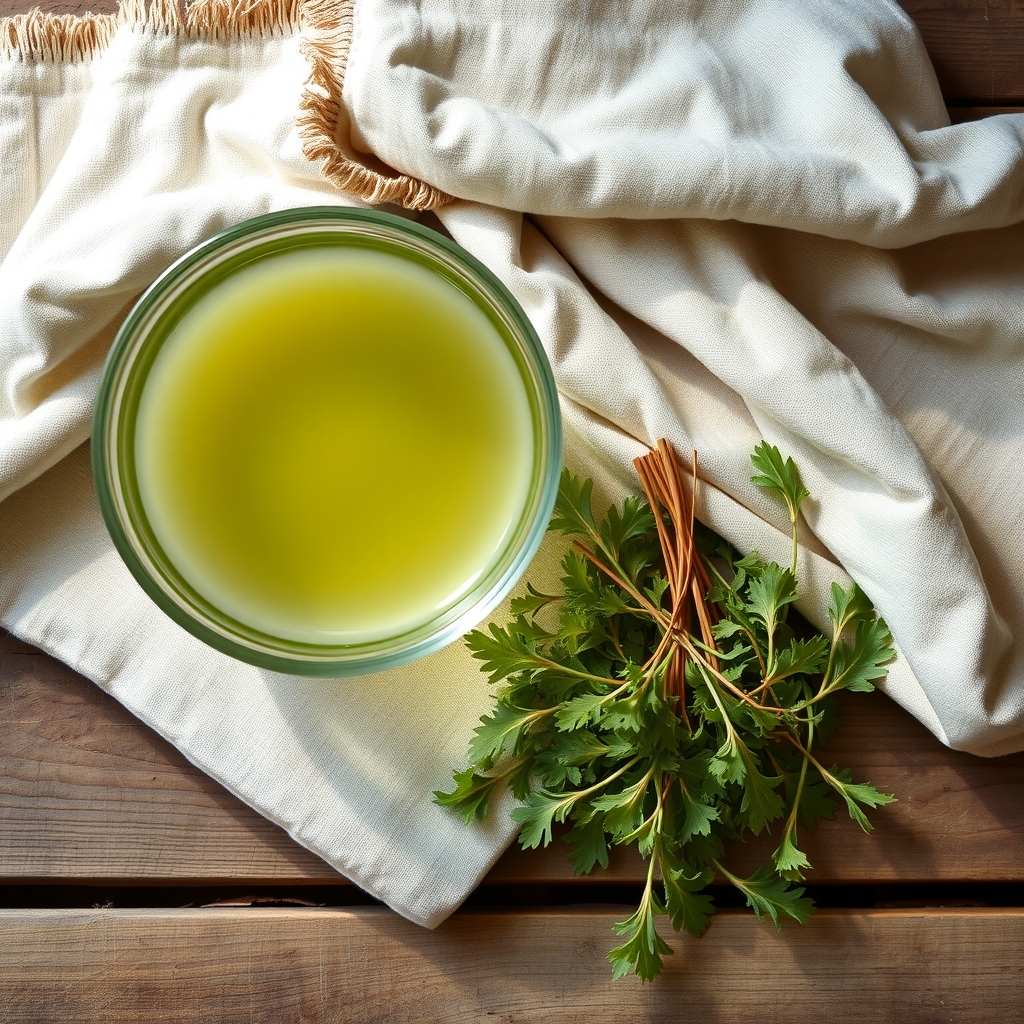
Long before bottled conditioners, people in many parts of Europe rinsed their hair with herbal teas made from whatever grew nearby. Stinging nettle, the weed that leaves an itchy rash on bare legs, was one of them.
Today nettle shows up in shampoos and in online lists of herbs for hair growth and dandruff. A homemade rinse is cheap and simple, but it is worth knowing how little the claims are backed by research, and how to avoid getting stung or irritated along the way.
Why people use it
Nettle rinses are part of folk hair care, used as a final rinse after washing with the hope of a healthier-feeling scalp and shinier hair. Nettle leaf is also a familiar herbal tea.
Interest in nettle for hair loss comes mostly from laboratory research, where scientists have looked at how nettle extracts behave in cells and in hair follicles kept alive in the lab.
Gentle Nettle Hair Rinse
You need
- dried nettle leaf2 tbsp
- freshly boiled water500 ml (2 cups)
Method
- Put the dried nettle in a heatproof jug or bowl and pour the boiled water over it.
- Cover and steep for 15 to 20 minutes.
- Strain through a fine sieve lined with a clean cloth or coffee filter so no leaf pieces remain.
- Let it cool completely, until it is lukewarm or at room temperature.
- Shampoo and condition your hair as usual and rinse well.
- With your eyes closed, slowly pour the rinse over your hair and scalp, massaging gently with your fingertips.
- Leave it in or rinse with plain water, then pat your hair dry.
Tips
- Use dried nettle rather than fresh. If you do pick fresh nettles, wear thick gloves and long sleeves.
- Make a fresh batch each time. Keep leftovers covered in the fridge and throw them away after 24 hours.
- If your scalp feels itchy or tight afterward, stop using it.
What the evidence says
The evidence for nettle on hair is thin. A 2025 review of plant remedies for hair loss, available through the US National Library of Medicine, describes the nettle research as mostly lab-based, using cells and isolated follicles, with very few trials in people. Lab results like these do not tell us whether a rinse helps real hair on a real scalp.
The European Medicines Agency reviewed nettle leaf and accepted it only for traditional uses taken by mouth. It decided that preparations applied to the skin were not suitable for its traditional-use review, and it did not accept skin complaints as a traditional use of nettle leaf.
The same report also gives the safety picture: fresh nettle can cause itching, skin inflammation and hives within moments of contact, and people who used fresh leaves on their skin in one study commonly reported a localized rash and slight itching.
So the honest summary is that a nettle rinse may feel refreshing, but there is no good evidence that it grows hair, stops hair loss or treats dandruff.
What actually helps dandruff
If flakes are your main concern, the American Academy of Dermatology recommends a dandruff shampoo with an active ingredient such as zinc pyrithione, salicylic acid, selenium sulfide, ketoconazole, sulfur or coal tar. If one type stops working, you can alternate between shampoos with different active ingredients, following the directions on the bottle.
The AAD also notes that persistent or severe dandruff can be a sign of another condition, such as seborrheic dermatitis, psoriasis, eczema or a fungal infection, which a dermatologist can diagnose and treat.
Questions people ask
Does nettle stop hair loss?
There is no good evidence that it does. The research on nettle and hair is mostly from lab experiments on cells and follicles, not from trials in people.
Will the rinse sting my scalp?
Dried and steeped nettle does not usually sting the way fresh leaves do, but any plant can irritate skin. That is why a 48-hour patch test on your arm comes first.
Can a nettle rinse replace dandruff shampoo?
No. Dermatologists recommend shampoos with proven active ingredients for dandruff. A rinse can be part of your routine if you enjoy it, but it is not a treatment.
Sources
- Assessment report on Urtica dioica L.; Urtica urens L., folium — European Medicines Agency
- Botanical drug preparations for alleviating hair loss in menopausal women: a global ethnopharmacological mini-review — PubMed Central, NCBI
- How to treat dandruff — American Academy of Dermatology
- Nettle — Memorial Sloan Kettering Cancer Center
This article is for general information only and is not medical advice. Herbs can interact with medicines and health conditions. Talk to a doctor or pharmacist before trying a herbal remedy, especially if you are pregnant, breastfeeding, giving it to a child, or taking any medication.